Table of Contents
As Friedrich Merz was ready to put together a cabinet, he pledged to assist in granting Europe “real independence” from the US.
Berlin:
Exit polls on Sunday indicated that Friedrich Merz will be the next German chancellor after the conservative alliance won the country’s national election. With the far-right Alternative for Germany (AfD), which had the support of well-known Americans like Elon Musk, the tech billionaire and President Donald Trump ally, making record gains and placing second, the outcome signaled a dramatic change in the political landscape of the nation.
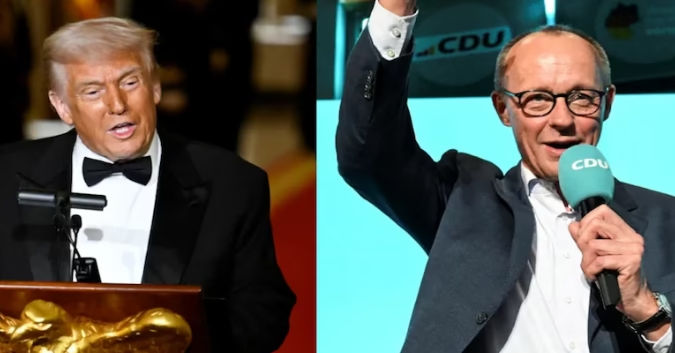
US President Trump praised the election results, claiming that the German people had rejected the center-left administration led by Olaf Scholz’s policies, which he described as “lacking common sense.”
“The German people, like those in the United States, became weary of the long-standing, nonsensical agenda, particularly with regard to immigration and energy. “Germany is having a fantastic day,” Trump posted on Truth Social.
Friedrich Merz Calls For “Real Independence” From US
As he was ready to put together a cabinet, Merz, 69, pledged to assist in granting Europe “real independence” from the US. Even while Trump celebrated the election’s conclusion, Merz attacked America in direct statements following his triumph and denounced the “ultimately outrageous” remarks made by Washington throughout the campaign, likening them to Russian unfriendly activities.
Therefore, achieving European unity is currently my top priority since we are under so much pressure from two sides. “European unity can be achieved,” he said during a discussion with other leaders.
Merz, who had previously been viewed as an Atlanticist, claimed that Trump had demonstrated that his government was “largely indifferent to the fate of Europe.”
stated that “absolute priority will be to strengthen Europe as quickly as possible so that we can achieve real independence from the USA step by step.” He even dared to inquire as to whether “NATO in its current form” will still be present at the upcoming summit of the North Atlantic Treaty Organization, which has supported European security for many years.
Merz, who has never held public office before, is expected to take over as chancellor at a time when Europe’s greatest economy is struggling, its culture is divided over migration, and its security is trapped between an aggressive China and Russia and a belligerent United States.
Tough Coalition Talks Ahead
The far-right AfD jumped to a record second position in a split vote following the dissolution of Chancellor Olaf Scholz’s ill-liked three-way partnership, forcing Merz to negotiate a complicated and drawn-out coalition even though they secured the lead. Since the AfD is still viewed as a pariah in a nation where far-right movements have historically been stigmatized due to the Nazi background, mainstream parties have rejected collaborating with it.
Merz does not have a strong negotiating hand going into coalition discussions. Despite being the largest group, his CDU/CSU had the second-worst post-war outcome. The future of minor parties is still unknown, which might confuse parliamentary math, as it is yet unclear if Merz would require one or two partners to obtain a majority.
It would be considerably more difficult for Germany to demonstrate obvious leadership in another three-way alliance.
Rise Of Far-Right
According to a forecast released late on Sunday by ZDF television, the conservative CDU/CSU coalition won 28.5% of the vote, followed by the AfD with 20.5%, after a campaign marred by violent attacks that resulted in the detention of people with migrant backgrounds.
Sunday’s outcome was simply the beginning for the AfD, which appears to be about to treble its score from the last elections. AfD leader Alice Weidel assured supporters, “Next time we’ll come first.” “Our hand remains outstretched to form a government.”
Fall Of Left-Centrists
According to the ZDF forecast, the Greens received 11.8% of the vote, while Chancellor Scholz’s Social Democrats (SPD) fell to their lowest proportion since World War Two, with 16.5% of the vote with Scholz admitting a “bitter” outcome.
The far-left Die Linke party gained 8.7% of the vote thanks to strong support, especially among younger voters.
The new Sahra Wagenknecht Alliance (BSW) party and the pro-market Free Democrats (FDP) were just below the 5% threshold needed to enter parliament.
Exit surveys showed that the turnout, at 83%, was the highest since before reunification in 1990. Female voters were more likely to favor leftist parties, but male voters tended to lean more to the right.